
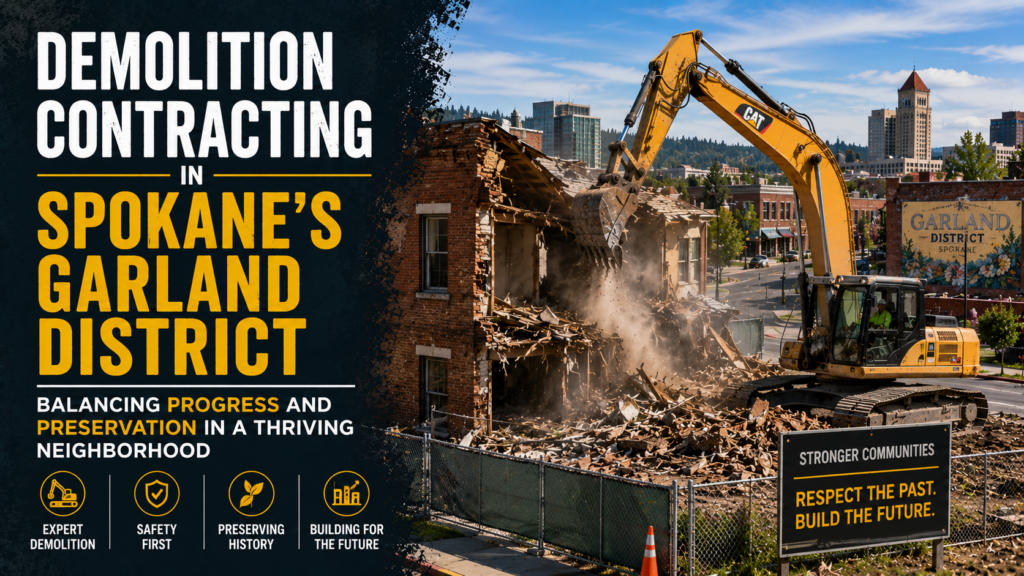
Spokane’s Garland District is experiencing a period of genuine momentum. Located a couple of miles north of downtown, the neighborhood has long been anchored by the historic Garland Theater a 1945 single-screen cinema designed in the Streamline Moderne style that has become a beloved community institution. Around it, a vibrant mix of coffee shops, bakeries, record stores, vintage shops, breweries, and arts spaces has transformed the district’s roughly six-block commercial corridor into one of Spokane’s most lively and distinctive neighborhoods.
This energy has brought new construction as well as preservation work to the Garland District, with apartment developments, commercial buildouts, and property improvements reshaping the neighborhood’s built environment. In this context, Demolition Contract Garland District play an important supporting role one that requires balancing the practical needs of new development with the community’s strong attachment to the district’s historic character.
The Garland District: A Neighborhood in Transition
The Garland District’s development began in the mid-twentieth century, and many of its commercial structures date from the 1930s through the 1950s, giving the area its characteristic architectural mix of Art Deco, Streamline Moderne, and simple mid-century commercial vernacular. The Garland Theater itself received the very first Historic Preservation Facade Improvement Grant awarded by the Spokane City-County Historic Preservation Office in 2019, with funds used to restore the building’s distinctive rooftop terra cotta tiling.
New residential development has arrived in the form of a four-story, sixty-unit apartment complex on North Wall Street directly north of the former Masonic Temple, as well as a forty-four-unit complex in the parking lot behind the Garland Theater itself. These projects reflect the broader housing demand in Spokane and the recognition, as one developer noted, that great cities thrive on a productive mix of old and new buildings.
Community voices in the Garland District have been attentive to how this new development shapes the neighborhood’s character. Some residents and business owners have advocated for exploring historic district designation, which would require new development and demolition to meet standards that maintain consistency with the existing architectural context. Others see new investment as fundamentally positive, provided it is done thoughtfully.
Types of Demolition Work in the Garland District
Demolition contracting in the Garland District encompasses a range of project types. At the residential scale, demolition work commonly includes the removal of garages and accessory structures, interior demolition for home renovations, and the full teardown of houses that have deteriorated beyond repair or are being replaced by new construction. The neighborhood’s housing stock, much of which consists of older craftsman homes, bungalows, and split-level ranchers, includes properties that range from well-maintained historic gems to structures that have suffered from years of deferred maintenance.
At the commercial scale, demolition may involve clearing interior spaces for tenant improvements, removing storefront elements as part of facade restoration, or preparing a site for ground-up construction. In each of these contexts, a skilled demolition contractor brings the same core competencies: hazardous materials assessment, proper permitting, safe and efficient structural removal, and responsible debris disposal.
Hazardous Materials in Older Structures
Given that a significant portion of the Garland District’s buildings date from the first half of the twentieth century, hazardous materials are a routine concern in demolition work here. Asbestos was widely used in building materials from the 1920s through the 1970s, appearing in floor tiles, ceiling tiles, pipe insulation, roofing materials, siding, and joint compounds. Lead-based paint was standard in homes painted before 1978. Both materials require identification, testing, and abatement by certified professionals before structural demolition can proceed.
Responsible demolition contractors conduct thorough pre-demolition surveys to identify any regulated materials and coordinate abatement with licensed specialists. This step protects workers, neighboring residents, and the environment, and it is a legal requirement for projects above certain thresholds. Property owners should always confirm that their contractor has a clear plan for hazardous materials before any demolition work begins.
Permitting and Compliance in Spokane
Demolition in Spokane requires permits from the city, and the process involves coordination with the building department, the historic preservation office when applicable, and utility companies. Permit fees from demolition projects regardless of whether the structure is historic or not are channeled into the city’s Historic Preservation Facade Improvement Grant fund, creating a direct financial link between the act of demolition and the preservation of remaining historic structures.
For properties located within or adjacent to a recognized historic district, additional review may be required. The Garland District is currently in discussions about potential historic district designation, and if that status is achieved, demolition applications would be subject to review against preservation standards. Property owners considering demolition work in the Garland area are advised to check the current status of any applicable historic designations before proceeding.
The Demolition Contractor’s Role in New Development
When new apartment buildings, commercial spaces, or mixed-use developments come to the Garland District, demolition contractors are typically among the first trades on site. Clearing existing structures, removing old pavement or concrete, grading the site, and managing the debris stream are all foundational tasks that create the conditions for new construction to begin.
This work requires coordination with civil engineers, architects, and general contractors to ensure that demolition activities proceed in a sequence that supports the overall project timeline. In an urban neighborhood like the Garland District where existing buildings, utility lines, active pedestrian traffic, and business operations are close at hand the ability to work safely and efficiently in constrained spaces is a critical skill for demolition professionals.
Community Values and Demolition Decisions
The Garland District’s community is deeply invested in its neighborhood’s identity. Business owners, residents, and neighborhood council members have spoken publicly about the importance of maintaining the aesthetic and historical character of the district, even as new development brings needed housing and economic energy. This perspective has practical implications for demolition work: the community expects that decisions about what to tear down are made carefully, with full consideration of what is being lost and what will replace it.
As one neighborhood council chair has noted, the goal is not to keep all new development out but to ensure that the aesthetics, history, and culture of the district remain intact. For demolition contractors working in the Garland District, this means approaching each project with an awareness of its broader context not just as a technical task but as a step in the ongoing story of a neighborhood that takes its identity seriously.
Conclusion
Demolition contracting in Spokane’s Garland District takes place in one of the city’s most dynamic and closely watched neighborhoods. The combination of historic architecture, active community engagement, new residential development, and ongoing revitalization investment creates a context in which professional demolition services are both in demand and subject to thoughtful scrutiny. Contractors who understand the neighborhood’s character, comply with Spokane’s permitting and preservation requirements, and work with care and transparency earn the trust of a community that is paying close attention to how its built environment is being shaped.